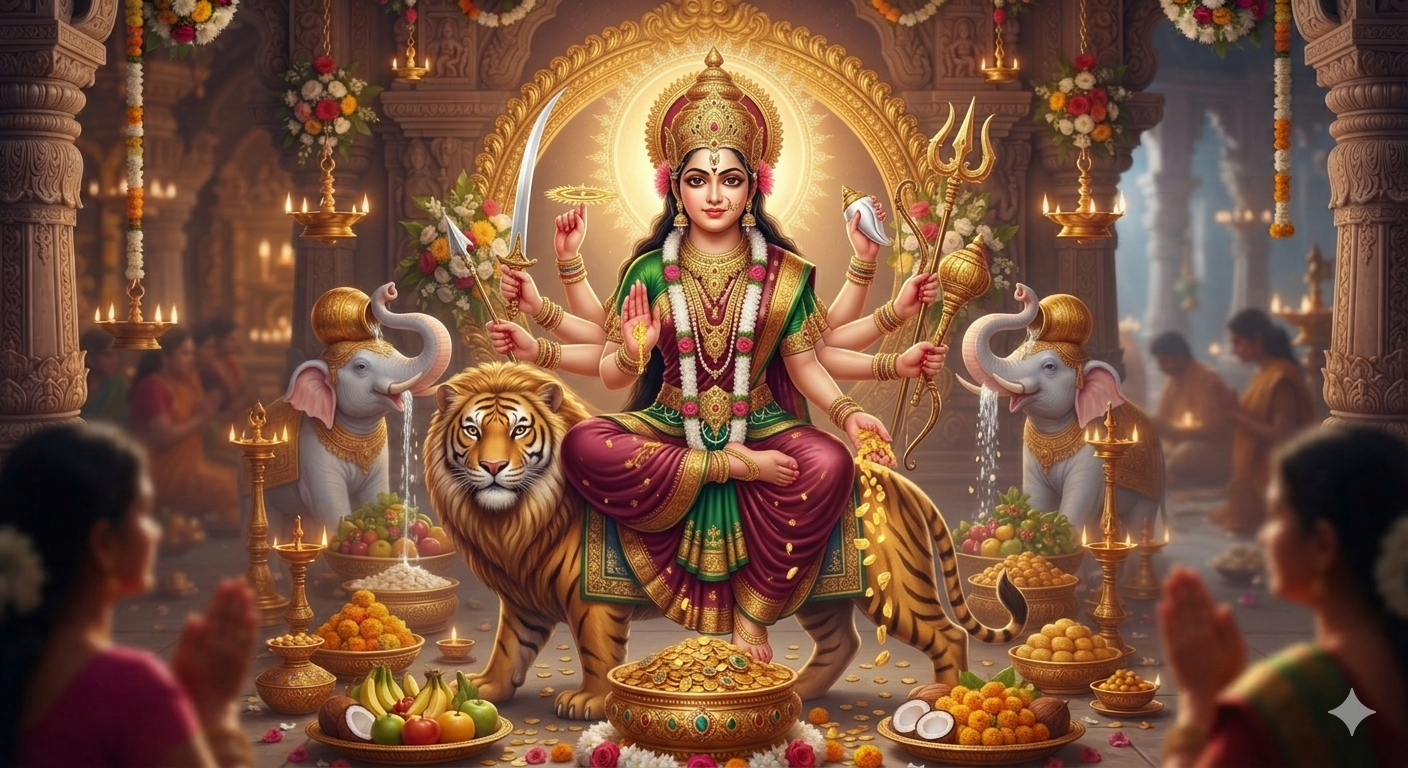
Goddess Durga
“Mahishasuramardini — the invincible fortress who slays the buffalo demon”
At a Glance
- Domain
- Protection of dharma, courage, destruction of evil
- Origin
- Combined radiance (tejas) of all gods united
- Consort
- None — self-established (Swayamsiddha)
- Vahana
- Lion / tiger
- Worship days
- Tuesday & Friday; Navratri nights
- Bija mantra
- ॐ दुं दुर्गायै नमः
- Forms
- Nine Navadurgas across Navratri
Stories & Legends
Born From a Thousand Suns
The buffalo-demon Mahishasura had a boon no man or god could kill him. His armies overran heaven itself; Indra fled to Brahma. Then Vishnu, Shiva and all gods concentrated their combined radiance into one point — and from that blazing summit of divine fire stepped Durga, eighteen arms already holding weapons gifted by each god. Her lion's roar shook three worlds.
— Devi Mahatmya
Nine Days Against Mahishasura
Mahishasura changed forms endlessly — buffalo, elephant, lion, warrior — each time escaping her blade. She matched every shift, laughing like thunder. On the ninth day she pinned the buffalo-form beneath her lion's paw, drove her trident through him as he shed disguises, and restored the heavens. The earth learned her name: Mahishasuramardini.
— Devi Mahatmya, Chapter 2–3
Raktabija — Every Drop a New Army
In the same war arose Raktabija: every drop of his blood touching ground birthed another clone of him — millions multiplying from wounds. Durga widened her mouth, drank his blood before it fell, and drained the endless army dry. Where strategy failed, ferocity fed on itself found its end.
— Devi Mahatmya, Chapter 8
The Daughter Who Visits Home
Bengal celebrates her as Uma — daughter of Himalaya and Menaka, married far away, returning with children Ganesha-Kartikeya for four precious autumn days. Pandals become art galleries, drums beat dhak, and on Dashami comes Sindoor Khela — married women painting her farewell red — then immersion in rivers, crying 'Asche bochor abar hobe': next year she comes again.
— Bengali Shakta tradition
Symbolism Decoded
🔱 Eighteen Arms
Collective grace — every god's gift aimed at protecting dharma.
🔱 The Lion Mount
Ego and anger tamed into service — power ridden, not obeyed.
🔱 Trident Through Mahisha
Three gunas piercing the beast of ignorance.
🔱 Red Sari
Action-energy (rajas) purified into protective love.
🔱 Unmarried Sovereignty
The feminine complete in herself — devotion by choice, not need.
Forms & Manifestations
Shailaputri
Navratri day one — daughter of the Mountain, riding a bull with trident and lotus.
Katyayani
Born of sage Katyayana's penance-fire — the warrior virgin worshipped for righteous marriage.
Chamunda
Emaciated fierce form who slew demons Chanda-Munda — bone-necklace terror for ego.
Siddhidatri
Navratri's ninth day — granter of eight supernatural accomplishments.
Sacred Texts & Mantras
Dum Bija Mantra
ॐ दुं दुर्गायै नमः
Om Dum Durgayai Namaha
"Salutations to Durga" — chanted nine times before travel, exams or any battle-like situation; tradition says it builds an invisible fortress around the chanter.
Ya Devi Sarvabhuteshu
या देवी सर्वभूतेषु शक्तिरूपेण संस्थिता। नमस्तस्यै नमस्तस्यै नमस्तस्यै नमो नमः॥
Ya devi sarvabhuteshu shakti-rupena samsthita | Namastasyai namastasyai namastasyai namo namah ||
"To the Goddess who dwells in all beings as Power itself — salutations again, salutations again." The Devi Mahatmya's thundering refrain, sung at dawn through Navratri.
How to Worship
Simple daily puja
Bathe before sunrise during Navratri; light a lamp facing the image, offer red hibiscus, vermillion, and seasonal fruit. Recite Durga Saptashati chapter or Argala Stotram; chant Dum bija 108 times. End with Aarti and prasad distribution.
Traditional offerings
- Red hibiscus & vermillion (sindoor)
- Seasonal fruits, panchamrit
- Chunri cloth & bangles offered to the goddess
- Halwa-puri-chana bhog on Ashtami
- Kanya pujan — feeding nine young girls on Ashtami/Navami
About vrat (fasting): Navratri fasts: fruit/milk-only or one meal; many observe all nine days annually — the kanya pujan (worshipping young girls as the goddess) is considered its crown.
Famous Temples
🛕 Vaishno Devi Shrine
Katra, Jammu & Kashmir
A 13-km cave trek in the Trikuta hills to three natural rock heads (Maha Kali, Maha Lakshmi, Maha Saraswati) — among Earth's most visited shrines, 10 million pilgrims yearly.
🛕 Kamakhya Temple
Guwahati, Assam
Nilachal hill's tantric powerhouse — where Sita... where Sati's yoni fell; the Ambubachi festival honours the goddess' annual cycle, celebrating fertility itself as sacred.
🛕 Chamundeshwari Temple
Mysore, Karnataka
Crowning Chamundi Hill above Mysore palace — the goddess who slew Chanda-Munda watches over the city whose Dasara procession began as her victory thanksgiving.
🛕 Ambaji Temple
Banaskantha, Gujarat
One of 51 Shakti Peethas where Sati's heart fell — no idol, only the Shri Yantra veiled in gold; millions climb Gabbar hill during Bhadarvi Purnima fair.
Festivals
🎉 Navratri & Durga Puja
Ashwin month (Sep–Oct)
Nine nights of garba-raas in Gujarat, pandal-hopping in Bengal, golu doll displays in Tamil Nadu — then Vijayadashami burning effigies and bidding farewell till next year.
🎉 Chaitra Navratri
Chaitra month (Mar–Apr)
Spring's nine nights beginning the Hindu new year — same nine goddesses, quieter observances, ending in Ram Navami.
Frequently Asked Questions
▸Why does Durga ride a lion?
The lion is raw power and pride — she rides it rather than being carried by it. The teaching: master your inner beasts and they become your vehicle.
▸What are the nine forms worshipped in Navratri?
Shailaputri, Brahmacharini, Chandraghanta, Kushmanda, Skandamata, Katyayani, Kalaratri, Mahagauri, Siddhidatri — one per night, tracing the journey from struggle to accomplishment.
▸Is Durga the same as Parvati?
Tradition sees them as one Shakti expressed differently — Parvati as the devoted homemaker, Durga as sovereign protector. Both are Adi Shakti wearing different contexts.