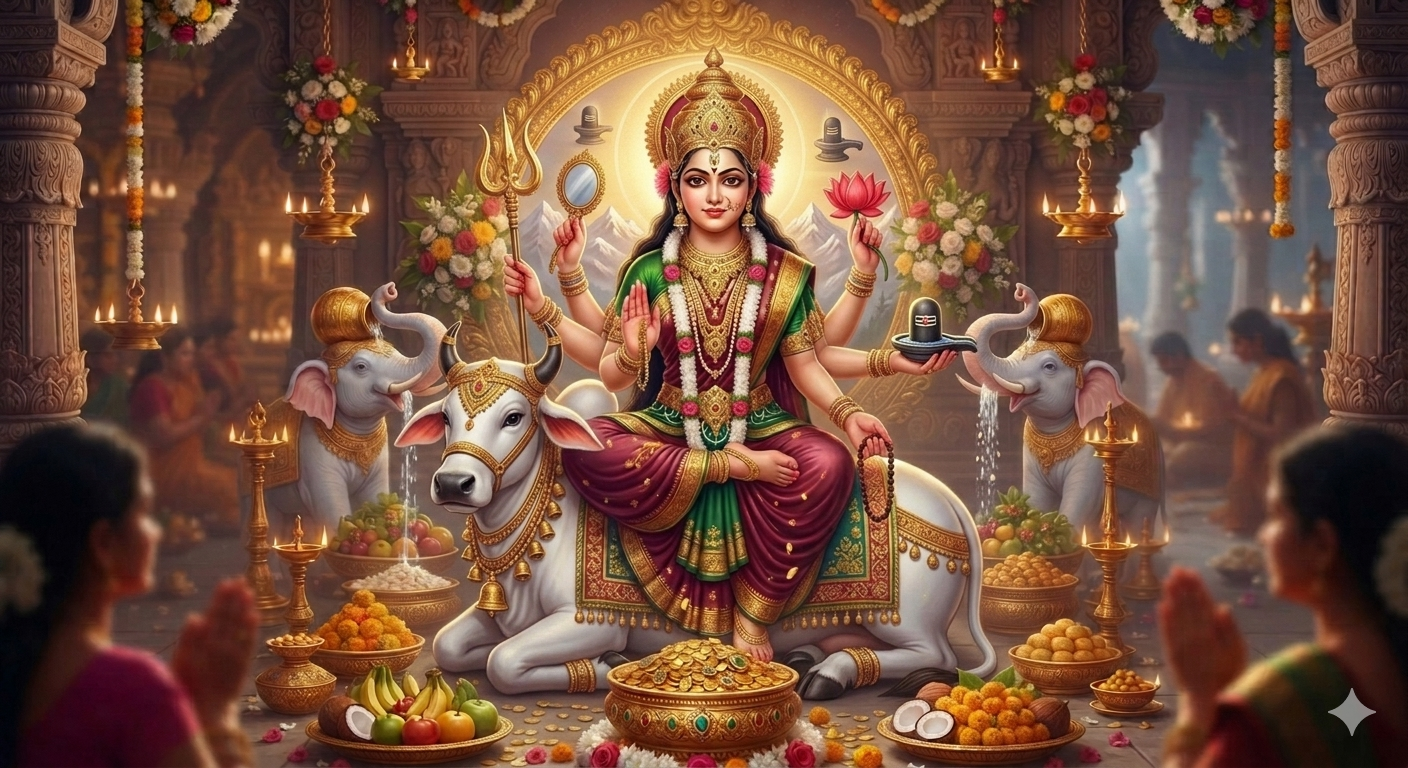
Goddess Parvati
“Adi Shakti — the mountain's daughter who won the ascetic”
At a Glance
- Domain
- Shakti — power, devotion, marital harmony, motherhood
- Parents
- Himavat (Himalaya) & Menaka; reborn of Sati
- Consort
- Lord Shiva — as Ardhanarishvara, one body
- Children
- Ganesha & Kartikeya
- Worship days
- Tuesday/Friday; Teej; Navratri
- Bija mantra
- ॐ ह्रीं पार्वत्यै नमः
- Great forms
- Durga · Kali · Gauri · Meenakshi
Stories & Legends
Sati's Return as the Mountain's Daughter
Sati had immolated herself at her father Daksha's insult of Shiva. Shiva withdrew into aeons of meditation, and the world lost its protective energy. Reborn as Parvati to Himavat and Menaka, the girl heard Shiva's name from sage Narada and knew. From childhood she collected bilva leaves for a shrine no one visited — worshipping the stone that would one day be her husband again.
— Shiva Purana, Rudra Samhita
Aparna — She Who Did Not Even Eat Leaves
To win Shiva, Parvati out-tapasya'd every sage: summer fires, winter waters, eating only leaves, then only air. Her mother cried 'U ma!' (don't!) — giving her another eternal name, Uma. When Shiva sent sages to test her resolve with insults about his ash-smeared ugliness, her fury was so pure it shook him from meditation. He came in person — and she still made him ask properly.
— Kumarasambhava by Kalidasa
The Marriage on Himavan's Peak
Himavan prepared his daughter like a queen; she arrived instead in bark-cloth and rudraksha — showing Shiva he wasn't marrying beauty but himself. The gods gathered; Brahma officiated as the mountain gave his daughter to the universe's yogi. That night Kailash celebrated — and creation regained its balance, because Shakti had come home.
— Shiva Purana
Turmeric, Play, and Ganesha's Birth
Long after marriage, playfully mixing turmeric paste for her bath, Parvati shaped a boy and breathed life into him — appointing him doorkeeper while she bathed. Shiva arrived unannounced; the loyal boy barred even him; the fateful strike followed. Parvati's grief demanded restoration — and the elephant-headed Ganesha emerged, making her the mother of the remover of obstacles.
— Shiva Purana
Symbolism Decoded
🔱 Half of Ardhanarishvara
Creation needs both consciousness and energy — neither is complete alone.
🔱 Mountain Origin
Stillness of Himalaya wedded to dynamism of Shakti — meditation married to action.
🔱 Mehndi & Marigolds
Teej traditions celebrate fidelity as sacred art, not obligation.
🔱 Lion Mount (as Durga)
Her own anger tamed into transport — emotion ridden toward purpose.
🔱 Annapurna's Bowl
Nourishment is divine duty — even the great yogi eats from her hand.
Forms & Manifestations
Gauri
The golden fair goddess of harvest and marital bliss — worshipped by brides across North India.
Meenakshi
Madurai's fish-eyed queen-goddess who rules before her husband — temple city itself built around her.
Durga & Kali
Her fierce emanations — protector and dissolver when gentleness cannot suffice.
Annapurna
Kashi's goddess of food — teaching that even Shiva must beg from her bowl.
Sacred Texts & Mantras
Hreem Bija Mantra
ॐ ह्रीं पार्वत्यै नमः
Om Hreem Parvatyai Namaha
Hreem is the heart-beat bija of Shakti — chanted for inner strength, harmonious relationships and awakening dormant courage.
Saundarya Lahari (Opening)
शिवः शक्त्या युक्तो यदि भवति शक्तः प्रभवितुं न चेदेवं देवो न खलु कुशलः स्पन्दितुमपि।
Shivah shaktya yukto yadi bhavati shaktah prabhavitum na chedevam devo na khalu kushalah spanditum api ||
"Only united with Shakti is Shiva able to create; without her, he cannot even stir." Adi Shankaracharya's opening verse — the entire philosophy of Shakti in two lines.
How to Worship
Simple daily puja
Fridays/Tuesdays: bathe, wear red or yellow, offer hibiscus, mehndi leaves, kumkum and sweets; light camphor and chant Hreem bija 108 times. Married women offer first portion of any sweet to her image.
Traditional offerings
- Red hibiscus, marigold & mehndi leaves
- Halwa, kheer & seasonal fruits
- Sindoor, chunri, bangles — suhag items
- Turmeric paste prepared fresh
- Green vegetables offered on Teej
About vrat (fasting): Teej vrat: nirjala for some, fruit-based for others — its essence is remembering one's own sacred commitments while swinging under monsoon skies.
Famous Temples
🛕 Meenakshi Amman Temple
Madurai, Tamil Nadu
Parvati born as Meenakshi, fish-eyed warrior-queen who conquered three worlds then met her match in Shiva — the 14 gopurams of this temple-city tower above everything.
🛕 Kamakhya Temple
Guwahati, Assam
Where Sati's creative power (yoni) fell — Ambubachi Mela celebrates the goddess' annual cycle, declaring fertility itself worship-worthy.
🛕 Kanyakumari Bhagavathy Temple
Kanyakumari, Tamil Nadu
Land's end where three seas meet — the virgin goddess stands here in eternal penance awaiting Shiva, her diamond nose-ring said to guide ships at night.
🛕 Annapurna Devi Temple
Varanasi, Uttar Pradesh
Beside Vishwanath — where Parvati taught Shiva that food is god: the legend says Kashi starved until Annapurna's kitchen reopened.
Festivals
🎉 Hariyali Teej / Hartalika Teej
Shravana & Bhadrapada (Jul–Sep)
Monsoon festivals replaying Parvati's penance: swings on trees, mehndi, green saris, songs of Gauri — women fast for suhaag just as she once did.
🎉 Navratri (as Adi Shakti)
Ashwin & Chaitra months
Nine nights honouring her nine forms — culminating in Vijayadashami, celebrating the victory that her own energy achieves through Durga.
Frequently Asked Questions
▸Are Parvati, Durga and Kali the same?
All are Adi Shakti — one supreme energy wearing different roles: devoted wife (Parvati), sovereign protector (Durga), fierce transformer (Kali). Like one actress in many profound roles.
▸Why did Parvati perform such severe penance?
Not to gain Shiva, but to become worthy of standing beside him eternally. Her Aparna tapasya teaches that union with greatness demands becoming great yourself.
▸What is Ardhanarishvara?
Shiva and Parvati as one half-and-half body — declaring that masculine and feminine are not rivals but two halves of every complete being.