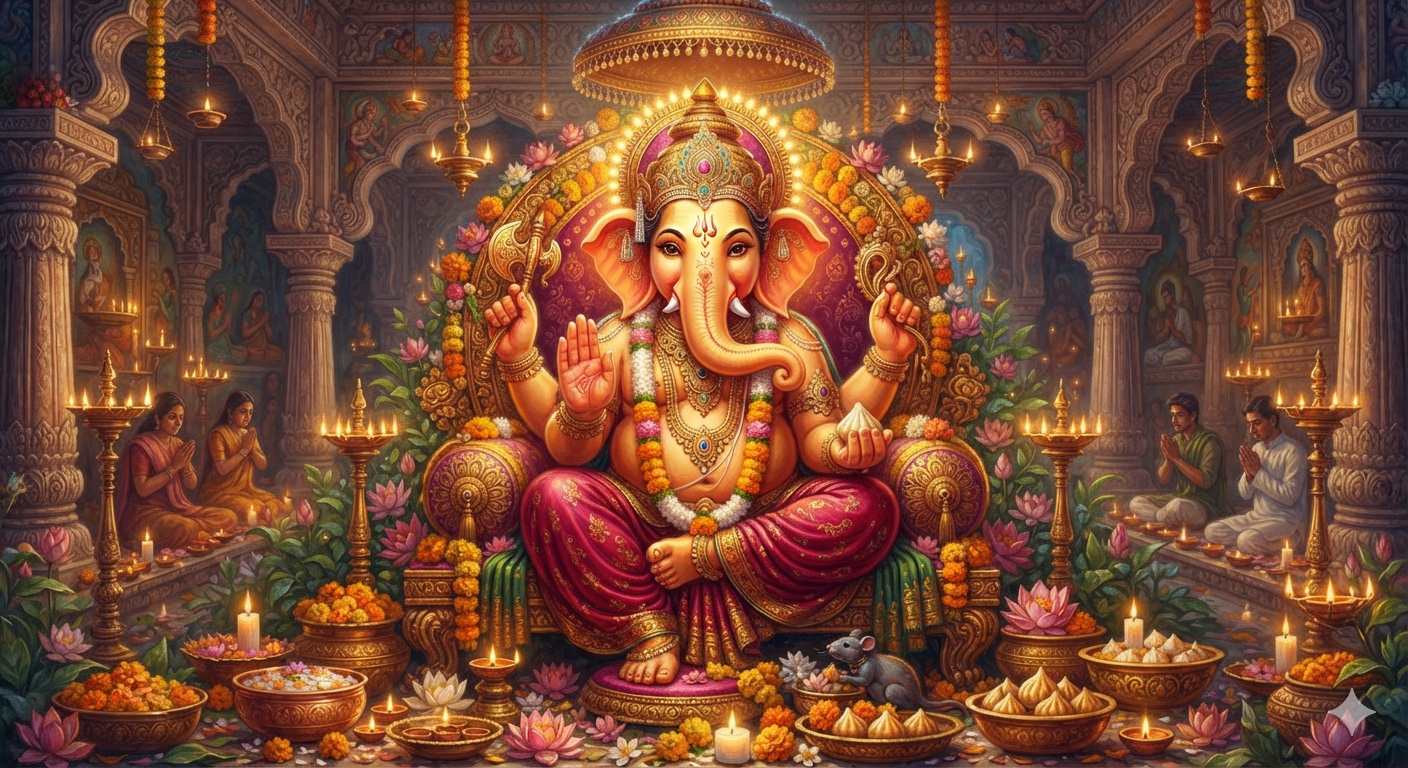
Lord Ganesha
“The Remover of Obstacles”
At a Glance
- Domain
- Beginnings, wisdom, obstacle removal
- Vahana (mount)
- Mushika — the mouse
- Consorts
- Buddhi (wisdom) & Siddhi (attainment)
- Worship day
- Wednesday; every Chaturthi tithi
- Sacred syllable
- ॐ गं (Gam bija)
- Family
- Son of Shiva & Parvati, brother of Kartikeya
Stories & Legends
How Ganesha Received His Elephant Head
The goddess Parvati, wishing for a devoted guardian, fashioned a boy from sandalwood paste and breathed life into him. She set him at her door with one instruction: let no one enter. When Lord Shiva returned and found his way barred, he did not recognise the boy as his wife's creation. A clash followed, and Shiva severed the child's head. Parvati's grief shook the cosmos, so Shiva sent his attendants to bring back the head of the first sleeping creature they met — an elephant. Placing it upon the boy, Shiva revived him, named him leader of the ganas (his celestial hosts), and decreed that all new undertakings would begin with his worship.
— Shiva Purana
The Race Around the World
The sages once offered a divine fruit, and both sons — Ganesha and Kartikeya — desired it. The challenge: whoever circled the world three times first would win. Kartikeya leapt onto his peacock and sped across continents. Ganesha, heavy-bellied and mounted on a tiny mouse, simply walked three times around his seated parents, then bowed: "My parents are my universe." The sages and Shiva himself were moved by this wisdom, and the fruit — often told as a mango — was his.
— Puranic tradition
The Curse of the Moon
After a feast of modaks, Ganesha rode home on his mouse. Startled by a serpent, the mouse stumbled and Ganesha tumbled, his belly bursting open sweets. He gathered them back and knotted the serpent as a belt — but the Moon above had laughed at the sight. Enraged, Ganesha cursed Chandra: whoever gazed upon him would earn false blame. When the gods pleaded, the curse was softened — its force limited to Ganesh Chaturthi night. To this day devotees avoid sighting the moon on that evening, reciting the story instead.
— Ganapati Atharvashirsha tradition
Symbolism Decoded
🔱 Broken Tusk
Sacrifice of perfection for purpose — tradition says he snapped it to scribe the Mahabharata when his pen failed.
🔱 Axe (Parashu)
Cuts the bonds of attachment; the swift severing of what holds us back.
🔱 Noose (Pasha)
Captures desires and distractions, drawing the mind back to truth.
🔱 Modak
The sweet reward of inner seeking — joy hidden within effort, like sweetness within the dumpling.
🔱 Mouse (Mushika)
Desire itself — small enough to gnaw through anything, yet mastered and ridden by wisdom.
🔱 Large Ears, Small Eyes
Listen much, speak less; see only what matters — the anatomy of focus.
Forms & Manifestations
Bala Ganapati
The child form — small, playful, holding sweets and fruit; beloved in household shrines.
Vira Ganapati
The valiant warrior form, armed with weapons in multiple arms, invoked for courage against adversity.
Nritya Ganesha
The dancing form, expressing cosmic joy; celebrated in classical art and temple sculpture.
Panchamukhi Ganesha
Five-faced form whose faces watch the ten directions — a Tantric representation of all-encompassing protection.
Sacred Texts & Mantras
Root (Bija) Mantra
ॐ गं गणपतये नमः
Om Gam Ganapataye Namaha
"Om and salutations to Ganapati" — the bija 'Gam' carries the essence of Ganesha's energy; chanted to clear obstacles before any venture.
Vakratunda Mahakaya
वक्रतुण्ड महाकाय सूर्यकोटि समप्रभ। निर्विघ्नं कुरु मे देव सर्वकार्येषु सर्वदा॥
Vakratunda Mahakaya Suryakoti Samaprabha | Nirvighnam Kuru Me Deva Sarva-karyeshu Sarvada ||
"O curved-trunk, mighty-bodied lord, radiant as ten million suns — remove every obstacle from all my endeavours, always." Traditionally recited at the start of work, studies or journeys.
How to Worship
Simple daily puja
Bathe and face east. Offer water, akshat (rice), flowers and durva grass while chanting the bija mantra 11 times. Light a ghee lamp and incense, offer modak or jaggery, then circumambulate once and seek blessings for the day's tasks.
Traditional offerings
- Modak or moong-laddu sweets
- Durva grass — exactly 21 blades
- Red flowers, hibiscus being most dear
- Jaggery and coconut
About vrat (fasting): Many devotees fast on Sankashti Chaturthi each month, breaking the fast only after moonrise darshan.
Famous Temples
🛕 Shree Siddhivinayak Temple
Mumbai, Maharashtra
Built in 1801, the temple's idol is unusual — the trunk turned right, considered especially potent. Lakhs visit each Tuesday seeking siddhi (fulfilment).
Best time to visit: Early morning on weekdays; Tuesday is most crowded
🛕 Mayureshwar Temple, Morgaon
Pune, Maharashtra
First among the eight Ashtavinayak shrines. Here Ganesha is worshipped as Mayureshwar, who slew the demon Sindhu riding a peacock.
Best time to visit: October–February; Ganesh Chaturthi draws huge crowds
🛕 Karpaga Vinayagar Temple
Pillayarpatti, Tamil Nadu
A rock-cut cave shrine over 1,600 years old, housing one of India's oldest Ganesha idols — a towering 6-foot image carved into living stone.
Best time to visit: November–March mornings
🛕 Idagunji Maha Ganapathi Temple
Idagunji, Karnataka
At the end of Dvapara Yuga, sages here received Ganesha's darshan; the two-handed idol standing in dvibhanga pose is rare and serene.
🛕 Chintaman Ganesh Temple
Ujjain, Madhya Pradesh
'Chintaman' means remover of worries. This ancient self-manifested shrine sits across the Shipra river; Rama is believed to have worshipped here.
Festivals
🎉 Ganesh Chaturthi
Bhadrapada month (Aug–Sep)
Ten days celebrating Ganesha's birth. Clay idols are installed at homes and pandals, offered daily worship, and carried in grand procession for visarjan (immersion) — famously grand in Maharashtra.
🎉 Sankashti Chaturthi
Every Krishna-paksha Chaturthi (monthly)
Monthly vrat observed with fasting until moonrise, when the moon is sighted through a sieve and prayers offered for the removal of sankat (troubles).
Frequently Asked Questions
▸Why does Ganesha have an elephant head?
Per the Shiva Purana, Shiva replaced the boy's severed head with that of an elephant to revive him. The elephant symbolises wisdom, memory and gentle strength — qualities of the god of beginnings.
▸Why is a mouse his vehicle?
The mouse represents restless desire — able to gnaw through anything. That wisdom rides it shows mastery over impulse rather than suppression of it.
▸What does the broken tusk signify?
It embodies sacrifice for a greater purpose. Ganesha is said to have broken it off to use as a pen while dictating the Mahabharata to Vyasa.
▸Why is he worshipped before every new beginning?
As Vighnaharta — the remover of obstacles — invoking Ganesha first asks that the path ahead stay clear. Even scriptures begin their invocations with him.