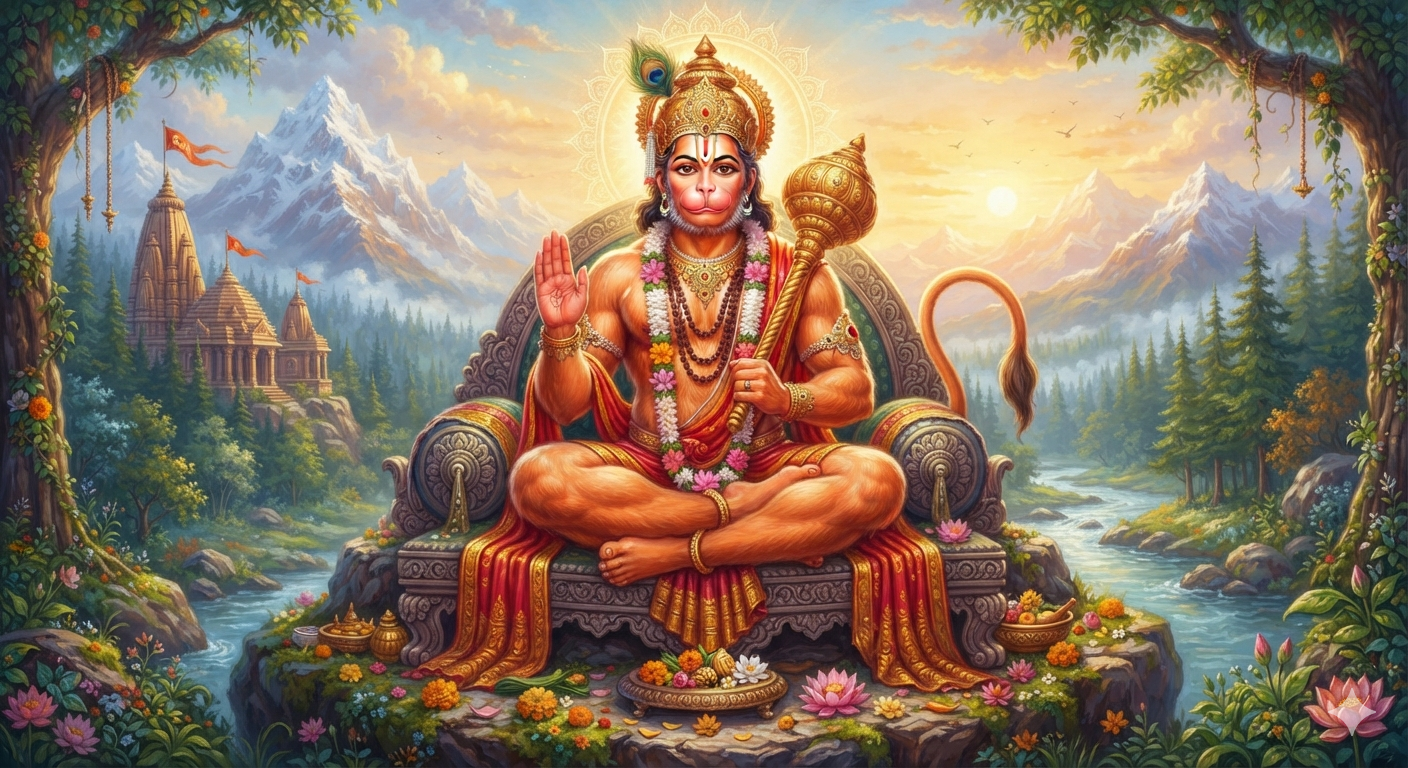
Lord Hanuman
“The living breath of devotion, strength and selfless service”
At a Glance
- Domain
- Bhakti, strength, courage, removal of fear
- Form
- Monkey-faced Chiranjivi (immortal)
- Parents
- Anjana & Kesari; borne by the Wind god Pavana
- Celibacy
- Eternal brahmachari
- Worship days
- Tuesday & Saturday
- Bija mantra
- ॐ हं हनुमते नमः
- Beloved names
- Bajrangbali · Sankat Mochan · Maruti Nandan
Stories & Legends
A Divine Birth — and the Swallowed Sun
Anjana, a devoted apsara turned forest-dweller, prayed for a son; through the blessings of Lord Shiva and the carrying grace of the Wind god Pavana, she bore a radiant child — part divine wind, part unshakable will. As a hungry infant he glimpsed the rising sun and, thinking it a ripe fruit, leapt skyward to swallow it. The heavens panicked: Indra hurled his thunderbolt, striking the child's jaw (hanu) and breaking it — giving him the name Hanuman. Restored by the gods with many boons, the mischievous child was cursed by sages to forget his own powers until someone remembered them for him.
— Padma Purana · Valmiki Ramayana, Uttara Kanda
"Remember Who You Are"
Years later, standing helpless on the shore while the search party despaired of crossing the endless ocean, Hanuman sat silent — powers erased by that ancient curse. Then the bear-warrior Jambavan spoke: "You are the son of the Wind. You crossed the sky as a child. Why do you lie like one who cannot?" As memory flooded back, Hanuman grew — vast, blazing, mountain-tall — and the army watched despair turn into certainty in a single moment.
— Valmiki Ramayana, Sundara Kanda
The Great Leap Across the Ocean
One hundred yojanas of water lay between him and Sita. Rising on Mount Mahendra, Hanuman stretched, roared like thunder, and flew. The ocean rose a mountain to greet him — Mainaka offered rest and fruits, but duty burned; he touched it gently and passed on. Then Surasa, mother of serpents, barred the way: "Enter my mouth." Growing enormous, then shrinking to a thumb-size mote, he slipped through her gullet and out — honouring her words and defeating the test. Finally Simhika tried to drag him down by his shadow; he plunged into her opened mouth and tore her apart. Lanka touched, mission begun.
— Valmiki Ramayana, Sundara Kanda
The Burning of the Golden City
To announce himself, Hanuman let himself be captured — knowing Ravana's court would humiliate an envoy. When the king ordered his tail set alight, oiled cloth was wrapped and fire lit. Hanuman simply lengthened the tail beyond all the cloth in Lanka, waited, then slipped free. With his blazing tail he leapt roof to roof — palaces, gates, arsenals aflame — while he himself stayed cool as moonlight. He spared one house alone: Vibhishana's, for a devotee's door stays untouched even amid righteous fury.
— Valmiki Ramayana, Sundara Kanda
He Carried the Mountain
Struck by Indrajit's weapon, Lakshmana lay lifeless. The old physician Jambavan whispered the only cure: four herbs from the distant Himalayan Dronagiri peak — and none but Hanuman could fly there before dawn. Arriving at the glowing herb-cliff, Hanuman could not tell Sanjivani from a thousand look-alikes. So he did what love does with impossibilities: he uprooted the entire mountain and lifted it skyward. Winds of healing swept the battlefield as he flew back; Lakshmana opened his eyes. Rama embraced him, eyes wet: "Lakshmana lives because of you."
— Valmiki Ramayana, Yuddha Kanda
The Heart That Held Rama and Sita
After the war, so beloved versions go, Sita gifted Hanuman a pearl necklace of rare beauty. Playfully he began biting each pearl apart. "Don't you value them?" they laughed. "I am checking which holds Rama," he said. "A pearl without my Lord inside has no worth." "But is Rama within you?" someone challenged. Without a word, Hanuman tore open his chest — and there, enthroned in the chamber of his heart, sat Rama and Sita together. This tender scene is not in Valmiki's epic; it is the gift of centuries of devotional imagination — and perhaps that makes it truer still.
— Folk & bhakti tradition
Symbolism Decoded
🔱 The Gada (Mace)
Strength under discipline — power that protects rather than dominates.
🔱 Saffron-Vermilion Hue
Total dedication. Folk lore says Sita wore sindoor for Rama's long life, and Hanuman — wanting his Lord to live forever — smeared it over his whole body.
🔱 The Leap Over the Ocean
Faith converts the impossible into a single step; limits live in memory, not in capability.
🔱 The Open Chest
Where there is absolute love, the Divine is visibly present.
🔱 Kneeling Humility
The mightiest being in the epics bows first — true power never needs to posture.
🔱 The Carried Mountain
No responsibility is heavy when it is lifted for dharma.
Forms & Manifestations
Veera Hanuman
The valiant standing pose — mace raised, tail curled high; invoked for courage against adversity.
Panchamukhi Hanuman
Five faces facing ten directions — Hanuman (east), Narasimha (south), Garuda (west), Varaha (north), Hayagriva (upward). Tradition says he took this form to extinguish five lamps at once and slay the sorcerer Ahiravana.
Sankata Mochan
The gentle seated remover-of-troubles — one hand raised in blessing; the form most worshipped in times of distress.
Bala Hanuman
The playful child reaching for the sun — reminding devotees that greatness begins as fearless curiosity.
Sacred Texts & Mantras
Root (Bija) Mantra
ॐ हं हनुमते नमः
Om Ham Hanumate Namaha
"Salutations to Hanuman" with the bija 'Ham' — chanted for courage, vitality and protection from fear.
Hanuman Chalisa — Opening Verses
श्रीगुरु चरन सरोज रज निज मनु मुकुरु सुधारि। बरनउँ रघुबर बिमल जसु जो दायकु फल चारि॥ बुद्धिहीन तनु जानिके सुमिरौं पवन कुमार। बल बुधि बिद्या देहु मोहिं हरहु कलेस बिकार॥
Shri guru charan saroj raj nij manu mukuru sudhari | Baranau Raghubar bimal jasu jo dayaku phal chari || Buddhihin tanu janike sumirau Pavan Kumar | Bal budhi bidya dehu mohin harahu kales bikar ||
Composed by Tulsidas in the Awadhi language — the Chaupais that follow praise thirty-six qualities of Hanuman; millions recite all forty verses daily, believing sincere chanting dispels fear and hardship.
Buddhir Balam Yasho Dhairyam
बुद्धिर्बलं यशो धैर्यं निर्भयत्वमरोगता। अजाड्यं वाक्पटुत्वं च हनूमत् स्मरणाद् भवेत्॥
Buddhir balam yasho dhairyam nirbhayatvam arogyata | Ajadyam vak-patutvam cha Hanumat smaranad bhavet ||
"By remembering Hanuman come intellect, strength, fame, patience, fearlessness, health, unflagging alertness and skillful speech." A beloved daily invocation of students and seekers alike.
How to Worship
Simple daily puja
Face east after bathing. Light a lamp, offer jasmine oil, sindoor, red flowers and jaggery-chana. Recite the Hanuman Chalisa — once daily, or eleven times on Tuesdays and Saturdays. Close with a moment of silence and one act of help for someone who cannot repay you.
Traditional offerings
- Jasmine (chameli) oil — his most beloved anointing
- Sindoor / saffron vermilion
- Red flowers and a red flag (dhwaja)
- Jaggery with roasted gram (gur-chana)
- Besan or boondi laddus
About vrat (fasting): Many observe fasts on Tuesdays and Saturdays; reciting the Sunderkand chapter over seven consecutive days is a cherished sankalp for overcoming long-standing troubles.
Famous Temples
🛕 Sankat Mochan Hanuman Temple
Varanasi, Uttar Pradesh
Established by the saint-poet Tulsidas himself, who composed the Hanuman Chalisa here. Devotees believe every genuine plea whispered in this courtyard finds its remedy.
Best time to visit: Tuesday & Saturday early mornings
🛕 Salasar Balaji Temple
Salasar (Churu), Rajasthan
Home of Balaji with the distinctive moustached, bearded face — an idol said to have self-manifested from the earth of a farmer's field in 1754.
Best time to visit: October–March; Chaitra & Ashwin fairs draw lakhs
🛕 Mehandipur Balaji Temple
Dausa, Rajasthan
Renowned as the seat of Sankat Mochan's healing power — thousands come seeking relief from afflictions believed beyond medicine.
Best time to visit: Tuesday & Saturday; avoid crowded ritual hours if faint-hearted
🛕 Jakhu Temple
Shimla, Himachal Pradesh
Perched on Shimla's highest hill — where Hanuman is said to have rested during his herb-mountain flight. The 108-foot orange statue watches over the valley below.
Best time to visit: Clear mornings for Himalayan views
🛕 Sri Anjaneyar Temple
Namakkal, Tamil Nadu
An awe-inspiring 18-foot monolithic Hanuman standing beneath the open sky, holding gada and Vedic palm-leaf — among South India's most revered Hanuman shrines.
Best time to visit: November–February mornings
Festivals
🎉 Hanuman Jayanti
Chaitra Purnima (Mar–Apr); regional dates vary across India
Celebrating Hanuman's appearance day — pre-dawn abhishek, sindoor offerings, Chalisa recitations through the night, and processions with saffron flags filling the streets.
Frequently Asked Questions
▸Why is Hanuman called Sankat Mochan?
"The liberator from troubles." Countless generations have testified that remembering him in crisis brings courage and a way forward — a reputation so strong that his most visited temples carry this very name.
▸Why do devotees offer sindoor and jasmine oil to Hanuman?
Folk tradition tells that Sita wore sindoor for Rama's longevity, and Hanuman covered his entire body with it so his Lord would live forever. Jasmine oil cools and honors the tireless deity; both offerings express total devotion.
▸Is Hanuman still alive?
Hindu tradition counts him among the Chiranjivis — the eight immortals — dwelling wherever the Ramayana is recited. Devotees speak of encounters across centuries; scripture presents his immortality as a granted boon.
▸Why are Tuesday and Saturday special for his worship?
Tuesday carries Mars-like martial energy matching his nature; Saturday is associated with discipline and endurance — both days are traditionally observed with Chalisa recitation, temple visits and fasting.
▸What does the five-faced Panchamukhi form represent?
Legend says Hanuman assumed five faces to extinguish five lamps burning in different directions at once — defeating the sorcerer Ahiravana. Spiritually, the five faces signify mastery over the five senses and directions.