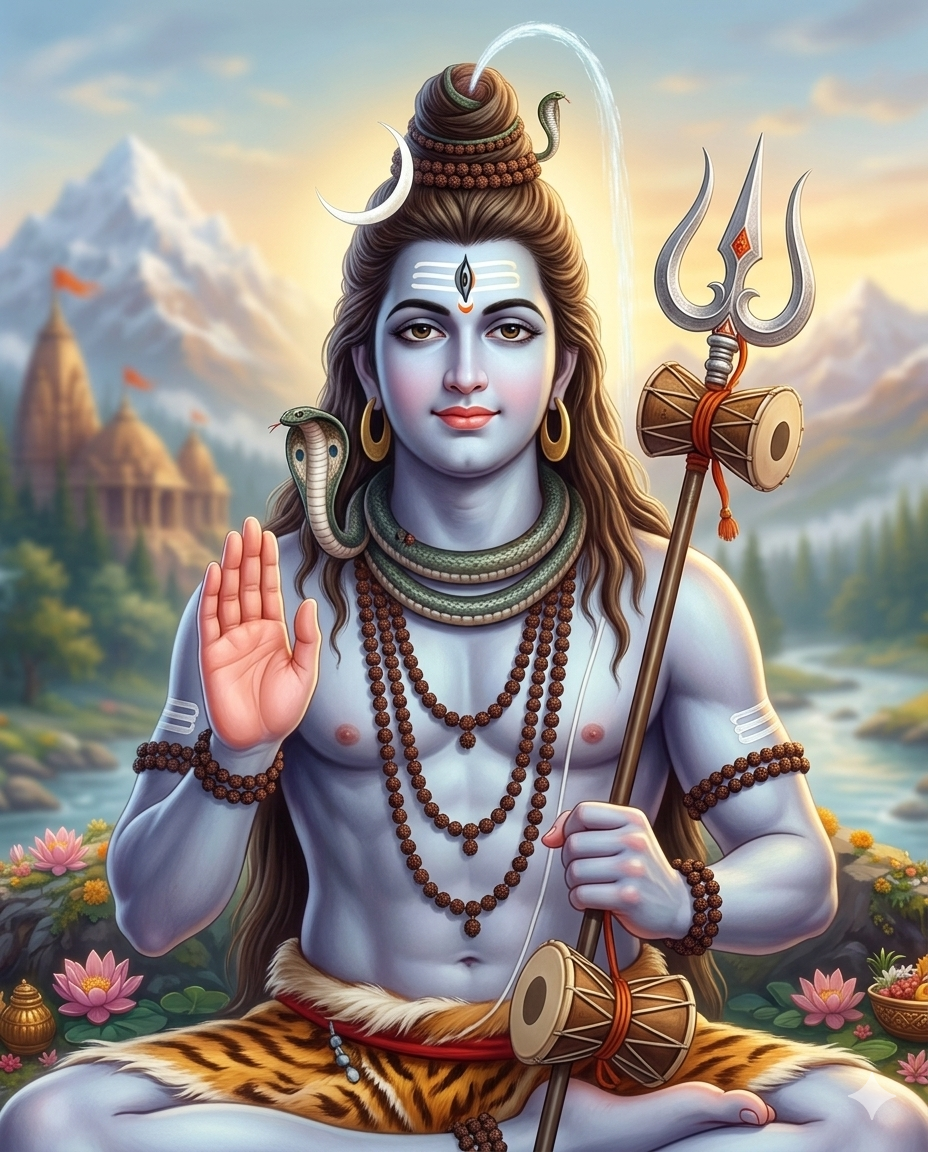
Lord Shiva
“Mahadeva — the auspicious transformer beyond time”
At a Glance
- Domain
- Yoga, dissolution & renewal, Time itself (Mahakala)
- Abode
- Mount Kailash
- Consort
- Parvati (Adi Shakti)
- Vahana
- Nandi the bull
- Worship day
- Monday; Pradosha; Maha Shivratri
- Bija mantra
- ॐ नमः शिवाय
- Family
- Parvati · Ganesha · Kartikeya
Stories & Legends
Neelakantha — The Blue Throat
When the churning of the ocean produced Halahala, a poison potent enough to end all fourteen worlds, every god and demon fled. Shiva alone walked forward, gathered the venom into his palm, and drank it. Parvati pressed his throat so it could not descend; the poison rested there eternally, staining his neck deep blue. From that day he is Nilakantha — blue-throated — proof that the Divine absorbs what would destroy creation.
— Bhagavata Purana
Ganga Descends Through His Hair
King Bhagiratha prayed for the celestial Ganga to descend and liberate his ancestors — but her fall would shatter the earth. Only one being could buffer a river of heaven. Ganga plunged onto Shiva's matted crown, wandered his tangled locks for years, and reached earth as a gentle stream. He is Gangadhara — supreme power expressing itself as shelter.
— Ramayana, Bala Kanda
The Third Eye That Ends Illusion
Absorbed in meditation atop Kailash, Shiva was disturbed by Kamadeva, god of desire, sent to break his tapasya. A single flicker of the third eye reduced Kama to ashes. Yet hearing Rati's grief, he restored Kama in subtle form — desire may return to the world, but never again to disturb the yogi. The third eye burns not flesh but illusion.
— Shiva Purana, Rudra Samhita
Nataraja — The Cosmic Dance
In the golden hall of Chidambaram, Shiva dances the Ananda Tandava — blissful creation and dissolution. One foot crushes Apasmara, the dwarf of forgetfulness; the drum beats creation, fire dissolves it; the raised palm says "fear not," the lifted foot points to liberation. In this bronze figure poets and physicists alike have seen the pulse of the cosmos.
— Chidambaram temple tradition
Ardhanarishvara — Half Woman, Half Lord
The sages of Daruka forest dismissed the feminine principle entirely. In response, Shiva manifested as half-man, half-woman — Parvati flowing seamlessly into his form. Creation is impossible without both stillness and energy: Shiva without Shakti is shava, a lifeless body, the scriptures say.
— Shiva Purana
Markandeya Conquers Death
Fated to die at sixteen, young Markandeya clasped the Shiva linga as Yama's noose closed in. The linga split open and Shiva burst forth, striking down Death itself — then granting the boy immortality. At Thirukkadaiyur this event is honoured even now: worship here asks not merely for years, but fearlessness before time.
— Skanda Purana
Symbolism Decoded
🔱 Third Eye
Wisdom that burns illusion — seeing what IS, beyond appearances.
🔱 Crescent Moon
Time mastered — months wax and wane in his hair like ornaments.
🔱 Trishula (Trident)
Mastery over waking, dreaming and deep sleep.
🔱 Damaru (Drum)
The primal sound from which creation vibrates forth.
🔱 Sacred Ash
Everything ends — worn as truth, not morbidity; ultimate detachment.
🔱 Nandi the Bull
Dharma and patience — the devoted mind eternally facing its Lord.
Forms & Manifestations
Nataraja
King of dancers — the cosmic rhythm of creation, preservation and dissolution.
Dakshinamurthy
The silent teacher facing south, transmitting wisdom without words to four sages.
Ardhanarishvara
Half-Shiva, half-Parvati — the inseparable union of consciousness and energy.
Kala Bhairava
The fierce guardian of directions who severs ego with terrible grace.
Sacred Texts & Mantras
Panchakshari — Five Syllables
ॐ नमः शिवाय
Om Namah Shivaya
"Om, salutations to Shiva" — the five syllables Na-Ma-Shi-Va-Ya are said to purify the five elements composing the body.
Maha Mrityunjaya — Victory Over Death
ॐ त्र्यम्बकं यजामहे सुगन्धिं पुष्टिवर्धनम्। उर्वारुकमिव बन्धनान् मृत्योर्मुक्षीय मामृतात्॥
Om Tryambakam yajamahe sugandhim pushti-vardhanam | Urvarukam iva bandhanan mrityor mukshiya mamritat ||
"We worship the three-eyed One, fragrant and nourishing; may He release us from death's bondage as a ripe cucumber slips its vine — by ripening, not severing." Chanted for healing and fearlessness.
How to Worship
Simple daily puja
Bathe early, face north or east. Offer water over a linga or Shiva image, then bilva leaves (stem toward you), white flowers, sandalwood paste and a ghee lamp. Chant Om Namah Shivaya 108 times. Mondays add milk abhisheka.
Traditional offerings
- Bilva (bael) leaves — trifoliate, stem facing self
- Raw milk, curd, honey, ghee (panchamrit abhisheka)
- White flowers & sandalwood paste
- Sacred ash (vibhuti) applied as three horizontal lines
- Dhatura fruit & rice — offered traditionally
About vrat (fasting): Pradosha vrata falls twice monthly on the 13th lunar evening — three hours around sunset are considered supremely auspicious.
Famous Temples
🛕 Kashi Vishwanath Temple
Varanasi, Uttar Pradesh
In the world's oldest living city, Shiva dwells as Vishwanatha — Lord of the Universe. Tradition holds that death here grants moksha directly.
Best time to visit: November–February; dawn aarti at the Ganges
🛕 Kedarnath Temple
Rudraprayag, Uttarakhand
A 1,200-year-old stone temple at 3,583 m — one of the twelve Jyotirlingas and Char Dham, where the Pandavas sought Shiva's forgiveness.
Best time to visit: May–June & September–October (closed in winter)
🛕 Mahakaleshwar Temple
Ujjain, Madhya Pradesh
The only south-facing Jyotirlinga — Mahakala, Lord of Time himself. The pre-dawn Bhasma Aarti, anointing the linga with sacred ash, is unlike any ritual in India.
Best time to visit: October–March; book Bhasma Aarti well ahead
🛕 Somnath Temple
Prabhas Patan, Gujarat
The first Jyotirlinga, where the moon god Soma was cured of a curse — destroyed and rebuilt six times through history, it rises again beside the Arabian Sea.
Festivals
🎉 Maha Shivratri
Phalguna month (Feb–Mar)
The great night of Shiva — devotees keep vigil all night, offering bilva leaves and milk abhisheka; tradition says even a sleepless thought of Shiva this night liberates.
Frequently Asked Questions
▸Why is Shiva called Mahadeva?
"The Great God" — because he precedes the gods themselves, absorbing destruction so creation can continue. Devotees also call him Ashutosh, easily pleased: a sincere heart outweighs elaborate ritual.
▸What does the linga symbolise?
The formless pillar of light — the symbol of reality beyond all shapes. The Skanda Purana says the linga appeared as an endless flaming column that Brahma and Vishnu could not measure.
▸Why is Shiva shown wearing ash and snakes?
Ash signals that everything burns to its essence — he wears impermanence as ornament. The snake around his neck shows death handled calmly, coiled like Kundalini energy mastered.
▸How is Shiva worshipped at home?
Simply: water over a linga or image, a bilva leaf, a lamp, and 108 repetitions of Om Namah Shivaya. Consistency matters more than ceremony — he is famously easy to please.