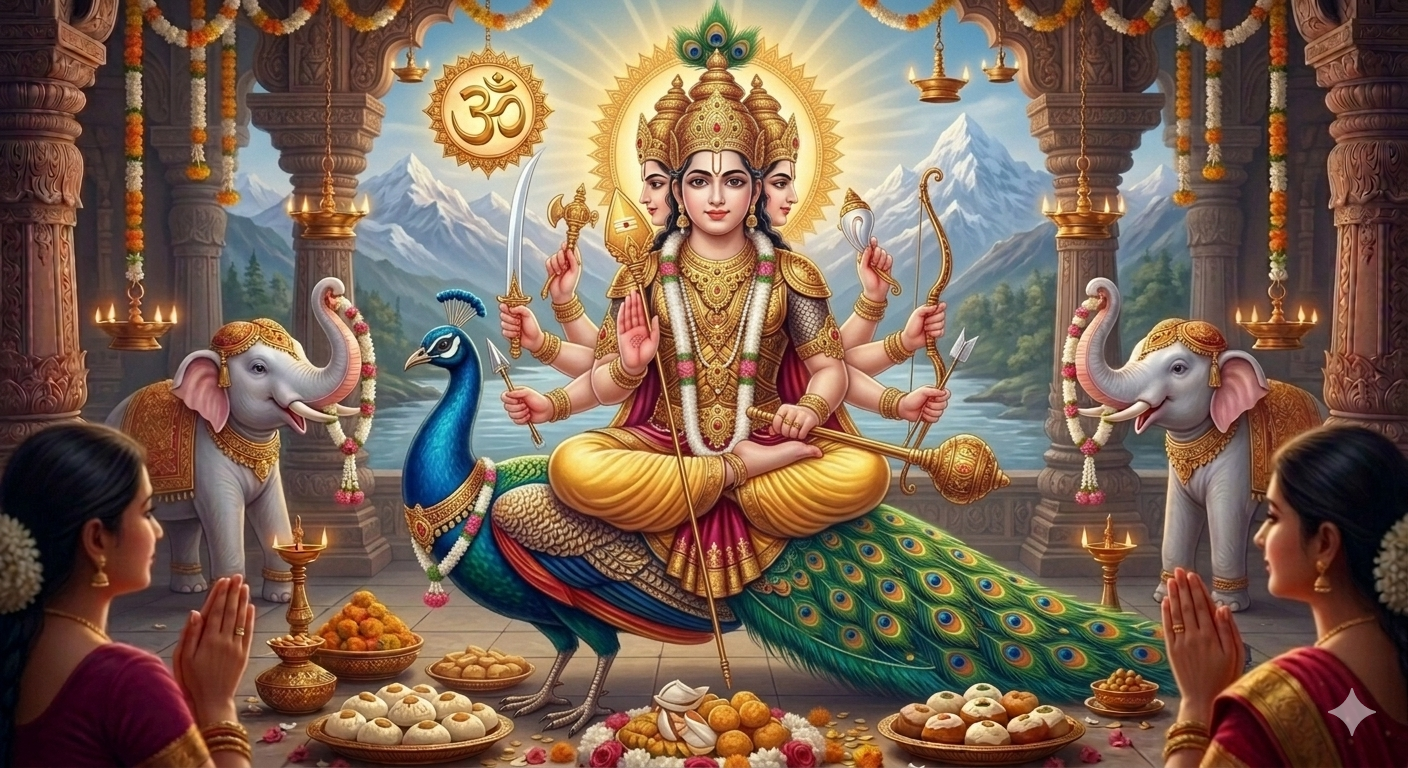
Lord Kartikeya
“Murugan — commander of the gods, bearer of the flaming Vel”
At a Glance
- Domain
- War, victory, youth, spiritual discipline
- Parents
- Shiva & Parvati; nursed by six Krittika sisters
- Consorts
- Devasena & Valli
- Vahana
- Peacock; rooster on his banner
- Worship day
- Tuesday; Skanda Sashti; Karthigai Deepam
- Maha-mantra
- ॐ सरवणभव नमः
- Sacred abodes
- Six Arupadai Veedu of Tamil Nadu
Stories & Legends
Born to End the Invincible
The demon Tarakasura held a boon: only Shiva's offspring could kill him. But Shiva was in deep meditation after Sati's loss. When Kamadeva's arrow rekindled love, six fire-sparks leapt from Shiva's third eye. Agni carried them to the Ganga, who bore them to a lotus lake in a reed forest (Sara-vana). Six Krittika sisters nursed the babies — and Parvati embraced all six into one body with six faces. The impossible child had arrived.
— Shiva Purana, Rudra Samhita
The Fruit of Wisdom
Narada brought a divine fruit — whoever ate it would gain all knowledge. Shiva set a contest: circle the world first. Ganesha circled his parents; Kartikeya mounted his peacock and flew around the globe. Returning triumphant, he found the fruit already with his brother — parents ARE the world. Hurt, the youth renounced Kailash for Palani hill, wearing only a loincloth: "I need nothing." Shiva followed, declaring him Gnana Pandita anyway — wisdom includes knowing when to walk away.
— Skanda Purana; Tamil tradition
Soorasamharam — Slaying Soorapadman
The demon brothers Surapadman, Tarakasura and Simhamukha tormented the worlds from their island fortress Veera Mahendrapuri. On the sixth night of battle, Kartikeya's Vel pierced Soorapadman mid-transformation into a giant mango tree — splitting it into a peacock (his mount) and a rooster (his banner). Even the enemy became ornament. Skanda Sashti recreates this victory annually with festival dramas.
— Kandha Puranam
The Two Brides — Devasena and Valli
Devasena, Indra's daughter, was given as war-prize consort — the goddess of armies wed to their commander. But Valli was a tribal huntress-girl whom Murugan wooed disguised as a hunter, through elephant-scares and honey-gathering games — until her foster father consented. Philosophy explains: Devasena is iccha-shakti (will), Valli kriya-shakti (action) — both must marry into one's practice.
— Kandha Puranam; Tamil Murugan tradition
Symbolism Decoded
🔱 The Vel (Spear)
Shakti's single point piercing ignorance — focus itself weaponised.
🔱 Peacock Mount
Vanity tamed into beauty-in-service; it displays its tail only when carrying him.
🔱 Rooster Banner
The cock's crow ends darkness — wakefulness against tamas.
🔱 Six Faces
Five senses plus mind — all six mastered and directed skyward.
🔱 Palani's Loincloth
Renunciation even after victory — the true conqueror needs nothing.
Forms & Manifestations
Dhandayuthapani
Palani's ascetic youth — staff in hand, shaven-headed, owning nothing yet radiating everything.
Shanmukha
Six faces watching six directions — master of the five senses plus the mind.
Devasenapati
Seated general on peacock-throne, reviewing celestial armies.
Balamurugan
The darling child form of Swamimalai who taught his own father the Pranava.
Sacred Texts & Mantras
Saravana Bhava Maha-mantra
ॐ सरवणभव नमः
Om Saravana Bhava Namaha
"Salutations to him born in the reed-forest" — five syllables said to activate the five elements within; Tamil devotees chant it thousands of times during Skanda Sashti.
Subramanya Bhujangam (Opening)
मयूराधिरूढं महावाक्यगूढं महासेव्यमानं सुरालिङ्गितोद्यत्। रुचाप्रीतये ध्यायति स्वन्तमेकं सुपुत्रं गुहं सन्ततं शरण्यम्॥
Mayuradhirudham mahavakya-gudham maha-sevyamanam sura-lingitodyat | Rucha pritaye dhyayati swantam ekam suputram guham santatam sharanyam ||
Composed by Adi Shankaracharya at Tiruchendur when Murugan appeared as a small boy feeding him milk — 'Ever I meditate in my heart on Guha, the refuge, riding the peacock, hidden in the great Vedic sayings.'
How to Worship
Simple daily puja
Bathe, wear clean clothes, face east or north. Offer red flowers, kumkum, vibhuti; chant Om Saravana Bhava 108 times. Recite Kanda Shashti Kavasam on Tuesdays; keep a small vel or peacock feather at the altar.
Traditional offerings
- Panchamritam (banana-honey-dates-ghee mixture)
- Red arali & lotus flowers
- Vibhuti & kumkum applied as three lines
- Panakam (jaggery water) during Skanda Sashti
- Peacock feather kept at the altar
About vrat (fasting): Six-day Skanda Sashti fast (fruit/milk only) culminating on Sashti day is considered supremely powerful for removing obstacles.
Famous Temples
🛕 Palani Dhandayuthapani Temple
Palani, Tamil Nadu
Hilltop shrine of the renunciate youth — reached by 690 steps or winch; panchamritam (fruit-honey mix) offered here is legendary, carried home by millions.
🛕 Thiruchendur Subramanya Swamy Temple
Thiruchendur, Tamil Nadu
Seashore temple where Soorasamharam happened — one of the Arupadai Veedu, unique for standing not on a hill but at the ocean's edge.
Best time to visit: October–November (Skanda Sashti festival)
🛕 Swamimalai Temple
Swamimalai, Tamil Nadu
Where child Murugan taught the meaning of Om to his own father Shiva — hence honoured here ABOVE Shiva's shrine, the only such placement.
🛕 Kukke Subramanya Temple
Sullia, Karnataka
Where Kartikeya protected the serpent race from Garuda — Nagasarpa dosha rituals draw devotees seeking relief from ancestral-curse afflictions.
Festivals
🎉 Skanda Sashti
Aippasi month (Oct–Nov), six days
Six days re-enacting the Soora war — Thiruchendur hosts dramatic Soorasamharam performances; devotees fast, chant Saravana Bhava, and walk to hill temples.
🎉 Thai Poosam
Thai month, Poosam star (Jan–Feb)
Kavadi Attam — devotees carry ornate arches, pots of milk, some piercing cheeks with vel-shaped skewers, walking barefoot to Palani/Batu Caves in trance-like devotion.
Frequently Asked Questions
▸Why does Kartikeya have six heads?
Born as six sparks, nursed by six Krittika sisters, then united by Parvati into one body — the six faces watch six directions, symbolising mastery over the five senses plus mind.
▸Why is he called Murugan in Tamil Nadu?
'Murugu' means tender beauty/youth. Tamil literature (Sangam era onwards) worships him as the god of the hills and of Tamil language itself — older than many Sanskrit narratives.
▸What is the significance of the Vel?
Given by Parvati, the Vel represents concentrated shakti — one pointed awareness that pierces ignorance instantly. Devotees carry vel replicas in Kavadi processions.