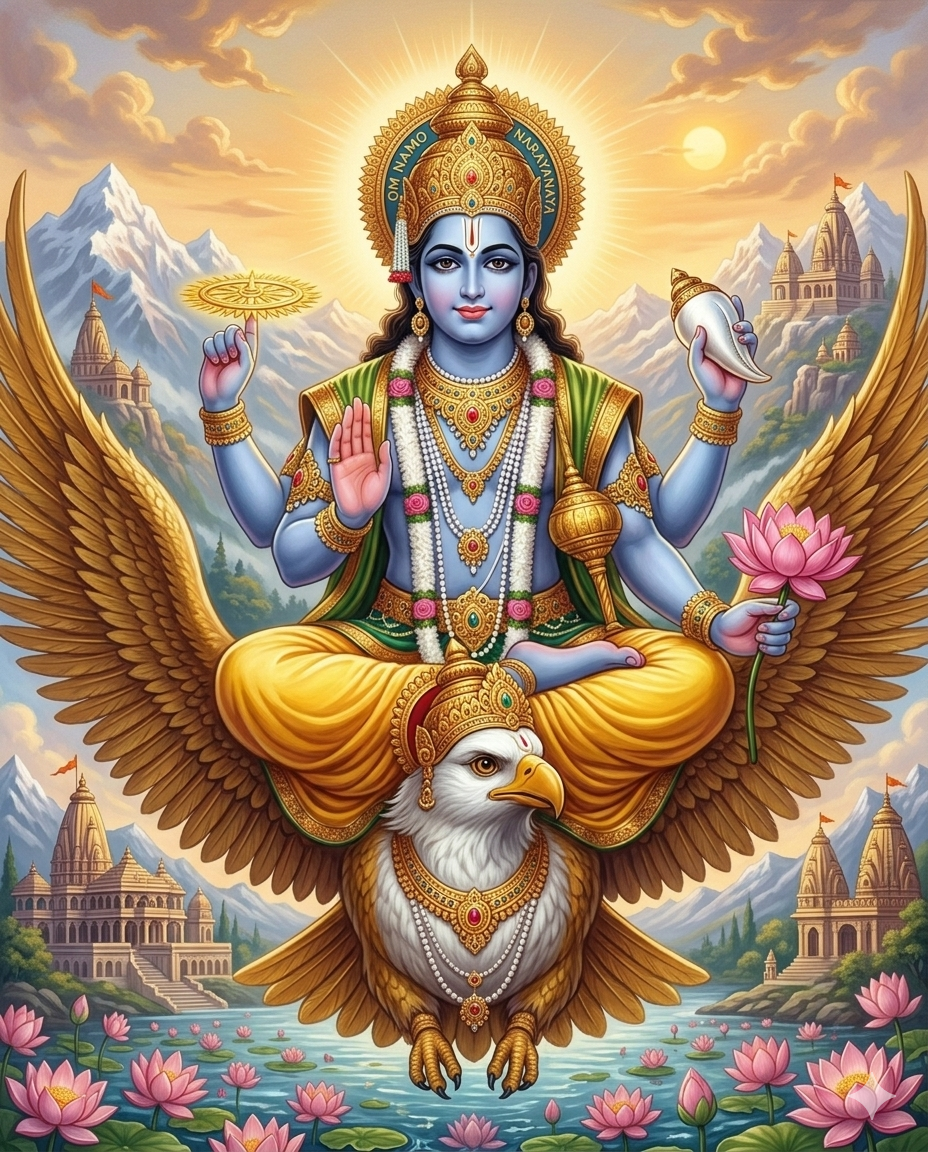
Lord Vishnu
“The Preserver who descends whenever dharma fades”
At a Glance
- Domain
- Preservation of cosmos, dharma & order
- Abode
- Vaikuntha, on Ananta-Shesha
- Consort
- Lakshmi
- Vahana
- Garuda, the divine eagle
- Worship day
- Thursday; every Ekadashi
- Bija mantra
- ॐ नमो भगवते वासुदेवाय
- Descents
- Ten principal avatars (Dashavatara)
Stories & Legends
Matsya — The Flood That Saved the Vedas
As the cosmic flood rose to drown creation, a great fish appeared to Manu, the forefather of humanity, warning: "Build a boat, gather the seeds of life." Towing the vessel through endless waters, Matsya protected Manu, the seven sages and the Vedas themselves — preservation in its most primal form.
— Matsya Purana
Kurma — The Turtle Who Carried a Mountain
Gods and demons needed the nectar of immortality from the ocean of milk, but the churning rod — Mount Mandara — kept sinking. Vishnu became a colossal turtle beneath the mountain, bearing its entire weight on his back while the cosmic churning spun forth amrita.
— Bhagavata Purana
Varaha — Lifting the Earth From the Depths
The demon Hiranyaksha dragged Mother Earth to the bottom of the cosmic ocean. Vishnu took the form of a mighty boar, dove into the abyss, and raised the drowning planet on his tusks — a battle of a thousand years won in a single triumphant lift.
— Bhagavata Purana
Narasimha — The Lion From the Pillar
Hiranyakashipu's boon made him near-immortal: not by man nor beast, not indoors nor outside, not by day nor night, not on ground nor in sky, not by any weapon. His own son Prahlada worshipped Vishnu anyway. When the demon struck a palace pillar asking "Is your God in this?" — it split, and Narasimha emerged: lion-man at dusk, on a threshold, holding the king on his lap, tearing him with claws. Every clause of the boon was honoured; none protected him.
— Bhagavata Purana, Canto 7
Vamana — Three Steps That Measured Everything
King Bali had conquered the three worlds through sacrifice. A radiant dwarf brahmachari approached asking just three paces of land. Bali smiled and agreed. Vamana grew beyond the horizon: one step covered earth, the second heaven — and for the third, noble Bali offered his own head. Pleased beyond measure, Vishnu named him ruler of the netherworld and his eternal doorkeeper — devotion measured, generosity rewarded.
— Bhagavata Purana, Canto 8
The Geeta's Charioteer Promise
"Yada yada hi dharmasya glanir bhavati bharata…" — Whenever dharma declines and chaos rises, I manifest myself. Spoken on Kurukshetra's battlefield as Krishna, this vow is Vishnu's signature across ages: preservation is not passive watching, but timely descent.
— Bhagavad Gita 4.7–8
Symbolism Decoded
🔱 Sudarshana Chakra
The discus of mind — spinning thoughts mastered into an instrument of dharma.
🔱 Panchajanya Conch
The primordial sound Om — creation begins when it is blown.
🔱 Kaumodaki Mace
Inner strength and the power of time over ego.
🔱 Padma (Lotus)
Purity floating unstained on existence's waters — liberation amid life.
🔱 Ananta-Shesha
Infinite time — the universe rests upon endlessness itself.
🔱 Garuda
Speed, loyalty and Vedic wisdom carrying the Divine.
Forms & Manifestations
Sheshashayi Vishnu
Reclining on the thousand-hooded serpent Ananta between cosmic cycles — the stillness that dreams universes.
Venkateshwara (Balaji)
Tirumala's Lord of Seven Hills — India's most visited shrine, fulfilling vows of millions.
Jagannath
Puri's 'Lord of the Universe' — iconic round-eyed form whose chariot festival draws oceans of devotees.
Vishvarupa
The Cosmic Form revealed to Arjuna — infinite mouths, worlds within, time itself devouring and giving birth.
Sacred Texts & Mantras
Dvadashakshari — Twelve Syllables
ॐ नमो भगवते वासुदेवाय
Om Namo Bhagavate Vasudevaya
"Om, salutations to Vasudeva, the indwelling Lord" — the maha-mantra of Vaishnavas, chanted for protection and surrender.
Karāgre Vasate Lakshmī…
कराग्रे वसते लक्ष्मीः करमध्ये सरस्वती। करमूले स्थितो ब्रह्मा प्रभाते करदर्शनम्॥
Karagre vasate Lakshmi karamadhye Saraswati | Karamule stito Brahma prabhate karadarshanam ||
"At fingertips dwells Lakshmi, in palms Saraswati, at the wrist Brahma — behold your hands at dawn." A morning verse sanctifying honest work as worship.
How to Worship
Simple daily puja
Bathe, wear clean clothes, face east. Offer tulsi leaves (never plucked on Ekadashi/Dwadashi), yellow flowers, sandalwood, and light a ghee lamp. Chant Om Namo Bhagavate Vasudevaya 108 times; read one Gita verse daily.
Traditional offerings
- Tulsi (holy basil) — the offering Vishnu loves most
- Yellow items: chana dal, bananas, gold-yellow flowers
- Panchamrit abhisheka (milk, curd, ghee, honey, sugar)
- Panjiri or makhan-mishri sweets
About vrat (fasting): Ekadashi fasts (24 per year) — full or fruit-only — are the supreme Vaishnava vrata; even sleeping during Ekadashi is traditionally avoided.
Famous Temples
🛕 Tirumala Venkateshwara Temple
Tirupati, Andhra Pradesh
On the Seven Hills stands Balaji — among Earth's most-visited sacred sites, receiving up to 100,000 pilgrims daily who fulfil hair-offering vows.
Best time to visit: Year-round; book darshan slots online months ahead
🛕 Sri Ranganathaswamy Temple
Srirangam, Tamil Nadu
The world's largest functioning Hindu temple complex — Ranganatha reclines on Shesha here, heartland of Sri Vaishnava tradition.
🛕 Shri Jagannath Temple
Puri, Odisha
One of the four Char Dhams. The annual Rath Yatra pulls three colossal wooden chariots through streets — devotees believe pulling the rope itself grants liberation.
Best time to visit: October–February; Rath Yatra in June–July
🛕 Badrinath Temple
Chamoli, Uttarakhand
Between Nar and Narayan peaks at 3,300 m, Badrinarayan sits in meditation — a Char Dham shrine reached through Himalayan switchbacks.
Best time to visit: May–June & September–October
Festivals
🎉 Vaikuntha Ekadashi
Margashirsha month (Dec–Jan)
The Vaikuntha Dwara (gate to heaven) opens in temples at midnight; fasting through this Ekadashi is said to equal years of austerities.
🎉 Devshayani & Prabodhini Ekadashi
Ashadha (Jul) & Kartika (Nov)
The Lord's cosmic sleep begins and ends — marking Chaturmasya, the four holy months of intensified practice.
Frequently Asked Questions
▸Why does Vishnu take avatars?
The Gita answers directly: "Whenever dharma declines, I manifest myself." Preservation means intervening at history's turning points — ten principal descents (Dashavatara) map exactly those moments.
▸What do Vishnu's four hands hold?
Conch (primordial sound), discus (mastered mind/time), mace (strength of dharma), lotus (liberation blooming in the world) — the complete equipment of the Preserver.
▸Who is older, Shiva or Vishnu?
Tradition refuses the ranking: Shaiva texts call Shiva supreme, Vaishnava texts Vishnu. Philosophically both are aspects of one Brahman — Harihara icons show them as one body.