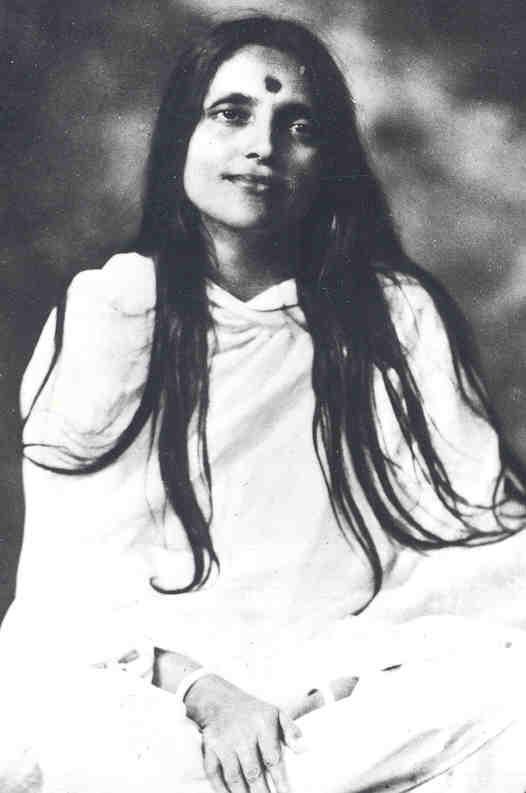
Anandamayi Ma
“The Joy-Permeated Mother — divine presence in human form”
At a Glance
- Birth name
- Nirmala Sundari (1896–1982)
- Birthplace
- Kheora village, Bengal (now Bangladesh)
- Guru
- None — declared self-luminous
- Husband
- Bholanath — became her first disciple
- Core teaching
- "Serve all, seeing the One in everyone"
- Major ashrams
- Kankhal (Haridwar), Varanasi, Vrindavan, Dhaka
- Famous devotee
- Indira Gandhi · Mahatma Gandhi met her too
Stories & Legends
A Childhood That Sang to Itself
Nirmala Sundari was born in a Brahmo-devoted family. Teachers marvelled that she never forgot a lesson after one hearing; villagers noticed she'd smile at nothing. At temple kirtans the little girl would sway into trance-like states. Her mother sometimes worried — this child seemed to live half in another world, humming divine names to herself as naturally as breathing.
— Anandamayi Ma biography tradition
The Wedding Night Instruction
Married at thirteen to Ramani Mohan Chakrabarti (Bholanath). On their first night together, she entered an ecstatic state and spoke with such authority about brahmacharya that her young husband accepted celibate companionship for years. Later he became her disciple formally — receiving mantra from his own wife. When questioned, Ma said: "Do you see any difference between husband and guru? The One is playing both roles."
— Recorded by Bhaiji (J.C. Roy)
Spontaneous Kriyas and the Name Given
During kirtans her body would perform perfect yoga postures never learned — breath stopping for long periods without harm, hands forming mudras of ancient rites. Witnesses gave her the name Anandamayi — 'permeated with bliss'. She herself said: "This body knows no effort; everything happens through it like water flowing downhill."
— Sad Vani recordings
"I Have Eaten the Whole World"
Once, absorbed in feeding devotees during a bhandara, Ma took morsels from every plate — eating impossibly vast quantities while remaining untouched by illness. When asked how, she laughed: "I have eaten the whole world today." For her there was no difference between serving food and receiving it — one consciousness playing both ends.
— Anecdotes recorded by close attendants
The Final Smile in Kankhal
In August 1982, aged 86, she told attendants her body's work was done. On the night of August 27 she breathed her last in Kankhal ashram — eyes open, face radiant. Her body was placed in a samadhi shrine at Kankhal where thousands still feel her presence. Devotees report the fragrance of sandalwood arising unexplained near her shrine even decades later.
— Recorded by attendants; ashram records
Symbolism Decoded
🔱 White Sari & Rudraksha
Renunciation worn lightly — total simplicity radiating total fullness.
🔱 Unconditional Smile
Bliss not dependent on circumstances — the nature of the Self itself.
🔱 Feeding With Own Hands
God serves God through every hand that gives.
🔱 No Guru, No Lineage
Truth needs no credential — it recognises itself.
🔱 Open Ashram Doors
Caste, creed, religion — all welcome; the Mother has only children.
Forms & Manifestations
The Smiling Presence
Seated on white cloth, wrapped in simple sari — her smile itself was darshan.
Ma in Kirtan Ecstasy
Standing amid akhanda nam-kirtan, swaying between worlds.
The Universal Mother
Feeding devotees personally — rice served with her own hands to hundreds daily.
Sacred Texts & Mantras
Ma's Core Teaching
सबमें एक ईश्वर देखो — सेवा ही सच्ची पूजा है। जप करो, सत्संग करो, प्रेम से रहो।
(Bhava) See the One in all — service is true worship. Do japa, keep satsang, live in love.
She taught less through doctrine than through presence — but repeated always: whatever path calls you, walk it wholly; the Name will carry you.
The Name She Loved
हरे राम हरे राम राम राम हरे हरे॥ (अखण्ड कीर्तन की परंपरा)
Hare Rama Hare Rama Rama Rama Hare Hare — the uninterrupted kirtan (akhanda naam) tradition she inspired continues non-stop in her ashrams since decades.
Ma encouraged each seeker to keep their own family mantra but add constant remembrance — 'let the Name hum beneath your breath even while working.'
How to Worship
Simple daily puja
No formal ritual needed — sit before her image, offer flowers, and practise what she asked: japa of your chosen Name, and one act of selfless service daily. Keep silence for five minutes before sleep.
Traditional offerings
- White & yellow flowers
- Khichdi or kheer offered then distributed
- Clothes/blankets donated to the poor in her name
- Feeding cows, birds and strangers alike
- Reading one Sad Vani page aloud
About vrat (fasting): She discouraged rigid fasting — 'the body is God's temple, keep it strong enough to serve.' Sattvic eating and daily service were her vrata.
Famous Temples
🛕 Anandamayi Ma Samadhi Shrine, Kankhal
Haridwar, Uttarakhand
Her Mahasamadhi shrine beside the Ganga — marble sanctum, continuous akhanda kirtan since 1982, and the evening aarti where thousands sing 'Jai Maa' as lamps float downriver.
Best time to visit: August 27 anniversary; Kumbh seasons
🛕 Anandamayi Ma Ashram, Varanasi
Varanasi, Uttar Pradesh
Mumukshu Bhavan near Bhadaini ghat where she stayed for extended sadhana periods — the room preserved exactly, kirtan hall echoing nightly.
🛕 Vrindavan Ashram
Vrindavan, Uttar Pradesh
In Krishna's eternal town, her small ashram keeps Gau-seva (cow care) central — cows she personally blessed are tended here generation after generation.
🛕 Shahbagh Ashram (heritage)
Dhaka, Bangladesh
Where the young Ma's kirtans first drew crowds in the 1920s — the original garden ashram remains a pilgrimage point for Bangladeshi devotees crossing borders of memory.
Festivals
🎉 Janmotsav (Birth Anniversary)
Vaisakha month (April–May)
Celebrated across all ashrams with akhanda kirtan, bhandara feeding thousands, and night-long satsang recalling her sayings.
🎉 Mahasamadhi Diwas
August 27 (every year)
Kankhal fills with devotees walking barefoot to the samadhi; the day closes with lamps floated on the Ganga carrying letters of gratitude.
Frequently Asked Questions
▸Was Anandamayi Ma considered an avatar?
She refused titles, but devotees experienced her as divine presence itself — born knowing. When pressed, she'd smile: "This body is nobody's; all bodies are mine."
▸How could she have no guru?
She explained: "Just as fire needs no instruction to burn," — her realisations were spontaneous, appearing as kriyas and wisdom without training.
▸What did she teach practically?
Three things consistently: keep the Name (japa), serve everyone as God, and surrender outcomes — tailored differently for each seeker who came.