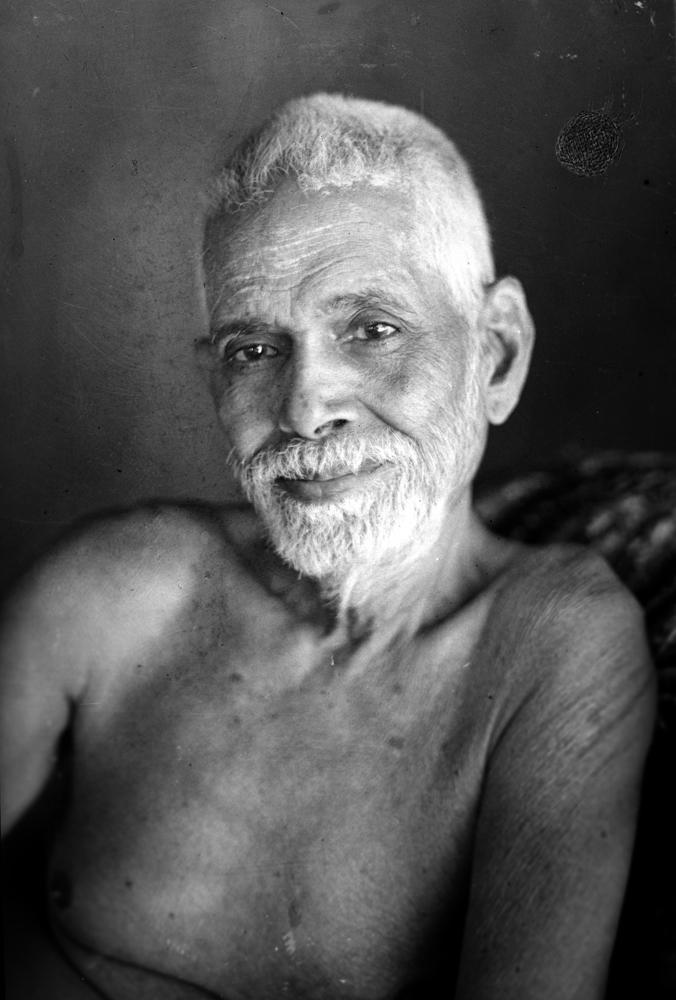
Ramana Maharshi
“The Sage of Arunachala who taught silence”
At a Glance
- Birth name
- Venkataraman Iyer (1879–1950)
- Realisation
- At age 16, in Madurai — the death experience
- Home mountain
- Arunachala, Tiruvannamalai
- Core teaching
- "Who am I?" — Self-inquiry (Atma Vichara)
- Mode of teaching
- Silence above words
- Ashram
- Sri Ramanasramam, Tiruvannamalai
- Lineage
- Self-declared — drawn home by the hill itself
Stories & Legends
The Death Experience at Sixteen
One afternoon a sudden fear of death seized sixteen-year-old Venkataraman. Instead of fleeing it, he lay down and simulated death — holding breath, stiffening limbs: "The body dies; let it die." In that instant he realised the 'I' that witnesses death never dies. Fear vanished permanently. The boy who entered the room and the sage who left were not the same person.
— Recorded by devotees; Day by Day with Bhagavan
"I Am Going" — The Journey to Arunachala
Weeks later, reading about Tiruvannamalai's sacred hill Arunachala, he felt the mountain calling. Leaving a note — "I am going in search of my Father" — he boarded a train with three rupees. Arriving half-dazed, he threw away his sacred thread and remaining clothes, had his head shaved, and sat motionless in the temple cellar for weeks — so absorbed that boys threw stones at 'the crazy sadhu'. He had come home.
— Self Realisation by B.V. Narasimhaswamy
Twenty Years of Silence in Caves
For nearly two decades Ramana lived in Virupaksha and Skandashram caves on Arunachala's slopes — often in complete silence, sometimes not speaking for months. Yet seekers found him: word spread of a young swami whose mere presence dissolved questions before they were asked. His first written teachings were answers scribbled silently on sand or paper for visitors.
— Sri Ramana Leela
Mother Comes Home
His mother Azhagalamma travelled twice to drag her son back — once even fasting outside his cave. He wrote her: "Whatever is destined to happen will happen..." She eventually returned to stay, became his disciple, served the ashram kitchen, and died there in peace. Her samadhi shrine, Matrubhuteswara, became the seed of today's Sri Ramanasramam.
— Letters from Sri Ramanasramam
The Cow Lakshmi
A devotee gifted an old cow named Lakshmi who walked straight to Bhagavan as if knowing him from lifetimes. She received daily blessings, was taught to knock gently for darshan, and died with her head in his lap — Ramana declared her liberated. Her samadhi stands beside human saints' in the ashram — equal moksha for a cow who loved rightly.
— Day by Day with Bhagavan
Symbolism Decoded
🔱 Arunachala Hill
Shiva as fire-column — the physical form of Self, which drew him home at sixteen.
🔱 Silence (Mouna)
The highest teaching: truth cannot be spoken, only transmitted.
🔱 'Who Am I?'
Not a mantra to repeat but a blade to trace every thought to its source.
🔱 The Unmoving Posture
Stillness is not inactivity — it is the universe settling into its source.
🔱 Equal Samadhis
Cow Lakshmi buried beside saints — liberation knows no species.
Forms & Manifestations
The Seated Sage
Cross-legged on the same white sofa for decades — unmoving stillness that itself was the sermon.
Mahakumbhabhisheka Murthi
His life-size statue at Matrubhuteswara temple, eyes half-open in eternal vichara.
The Silent Dakshina
His mode of teaching — sitting in mouna while questioners' minds quieted into answers.
Sacred Texts & Mantras
Nan Yar — Who Am I? (Essence)
सर्व वेदान्तों का सार यही है — चिंतन के द्वारा 'मैं' की परिधि से परे जाना।
The essence of all Vedanta: trace every thought to its root — hold to the pure 'I-I', and thoughts dissolve like waves into ocean.
His only prose teaching, dictated at 22: when other thoughts arise, ask 'to whom does this arise?' — 'To me.' Hold the 'I' until it dissolves into its source. That dissolution is realisation.
Aksharamanamalai (Opening)
अरुणाचलं शिवमूर्तिं रामणमहर्षिं चिन्तये॥ (भाव) — हृदयगुहा में ज्योति स्वयं अरुणाचल है।
(Bhava) The heart-cave's light is itself Arunachala — I have sought and found my husband within.
His 108-verse bridal hymn to the hill, composed in ecstatic longing — Arunachala addressed as beloved Lord who must claim his bride.
How to Worship
Simple daily puja
No ritual required — his instruction: sit comfortably, ask 'Who am I?', attend to the sense of 'I' until thoughts subside. Ten minutes daily outweighs hours of ceremony. Visit his image, bow, be silent for a minute.
Traditional offerings
- Silence — the offering he valued most
- Fresh jasmine & lotus if desired
- Camphor flame before his portrait
- Fruit for the ashram cows in his memory
- Reading one Nan Yar passage slowly
About vrat (fasting): Girivalam on full-moon nights (barefoot 14km around Arunachala) is the practice he himself recommended above all rituals.
Famous Temples
🛕 Sri Ramanasramam
Tiruvannamalai, Tamil Nadu
The ashram grown around his mother's samadhi — daily Veda parayana at dawn, silent satsang in the old hall where he sat for 28 years, bookshop carrying every recorded word.
🛕 Arunachala Hill & Girivalam Path
Tiruvannamalai, Tamil Nadu
14-km barefoot circumambulation of the holy hill — especially on full moons, said to burn away lifetimes; Ramana called simply walking it the greatest pilgrimage.
🛕 Virupaksha & Skandashram caves
Tiruvannamalai, Tamil Nadu
The slope-side caves where he spent twenty silent years — preserved exactly, with his spring-water well still flowing for pilgrims.
🛕 Annamalaiyar Temple (base of hill)
Tiruvannamalai, Tamil Nadu
Massive Shiva temple at Arunachala's foot — site of the Karthigai Deepam flame lit atop the hill each Nov–Dec, visible for miles; Ramana witnessed it as 'the true festival'.
Best time to visit: Nov–Dec Karthigai Deepam; any full-moon Girivalam night
Festivals
🎉 Ramana Jayanti & Aradhana
December (birth) · April–May (Aradhana)
Birth anniversary celebrated with abhishekam of the statue and Vedic chanting; Aradhana marks his Mahanirvana day when a shooting star was seen crossing the sky.
🎉 Karthigai Deepam
Karthigai month (Nov–Dec)
The great beacon lit atop Arunachala with ghee-cloth wicks — Ramana witnessed the flame leaping forth spontaneously, calling it 'the mind merging in the heart'.
Frequently Asked Questions
▸What is self-inquiry (Atma Vichara)?
Tracing every thought back with 'To whom does this arise?' — to me. Then holding the bare sense of 'I' without naming it, until it dissolves into its silent source. Not repetition — attention.
▸Why did Ramana teach mostly through silence?
He said words can only point; the truth of the Self transmits directly in presence. Devotees report minds going quiet just sitting near him.
▸Did Ramana have a guru?
He declared Arunachala the hill itself was his guru — it called him at 16 and completed his realisation. No human initiation; lineage began with him.